
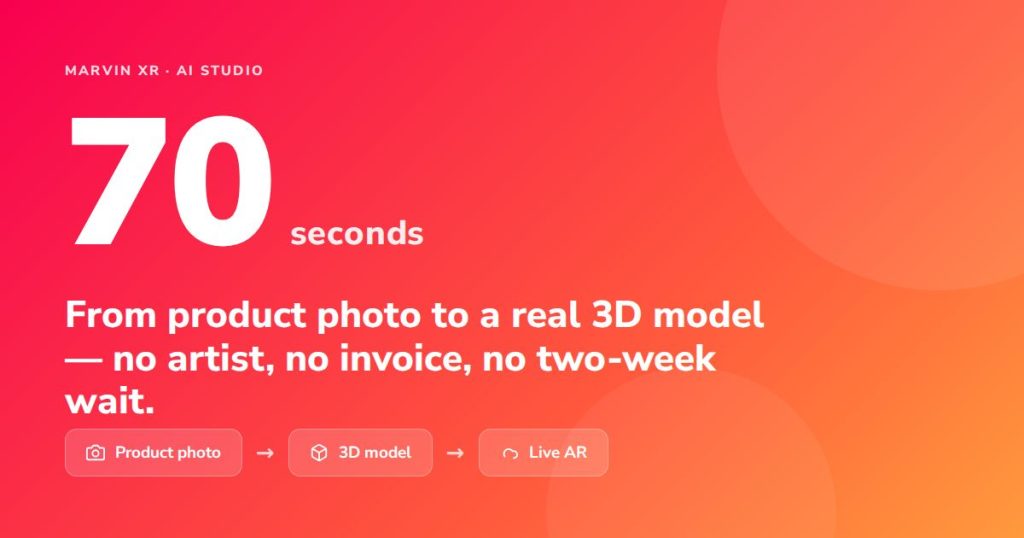
The short version: a 3D model used to cost a freelancer’s invoice and a two-week wait. Now it costs three product photos and about a minute. Here’s what changed, and why it matters more than most ecommerce teams realize.
The old math never worked for most catalogues
Ask any ecommerce or 3D team how they got their first AR-ready model made, and you’ll hear some version of the same story: a freelance 3D artist, a brief that went back and forth for a week, a per-SKU quote somewhere between $50 and $300, and a delivery date that assumed nothing went wrong. For a hero product or two, that’s tolerable. For a catalogue of 200 SKUs, it’s a budget line that kills the project before it starts — which is exactly why so many furniture and home brands still don’t have a single 3D model live, despite knowing shoppers want one.
The bottleneck was never the value of 3D. Every study on furniture ecommerce says the same thing: shoppers who can see true scale and rotate a product convert at meaningfully higher rates and return items less often. The bottleneck was production — a manual, artist-dependent pipeline that doesn’t scale to a real catalogue.
AI Studio: the step everyone else starts with is the step we removed
Marvin XR’s AI Studio turns one to three ordinary product photos — the kind already sitting in your product feed — into a textured, PBR-shaded 3D model in roughly 70 seconds. No LIDAR rig, no studio scan, no freelancer brief. You upload what you already have, and the model comes back ready to inspect, resize, and publish.
- One to three photos in. Multiple angles improve the result, but a single image is enough to get a usable model.
- A real GLB out, in about a minute. Not a preview or a placeholder — an inspectable, resizable mesh you can publish immediately or download and refine elsewhere.
- Real-world scale, baked in. Enter the actual width, height and depth once, and every AR placement after that is true to size — with an optional on-screen dimension overlay so the shopper never has to guess.
- One click to a live campaign. Publishing a model provisions a hosted AR viewer with its own URL, a branded QR code, and an iframe snippet for your product page — no separate dev project required.
One model, reused everywhere — not spent once
The other cost nobody budgets for is the second use. A model commissioned for one product page usually stays on that one product page, because re-purposing it for a paid ad, a size-comparison graphic, or a social clip means going back to whoever made it. Marvin XR treats the model as a reusable asset from day one: the same GLB becomes a packshot, a 3D video, a CGI scene, a paid ad creative, a size reference, and the live AR experience itself — generated once, reused for every placement, with no reshoot and no second invoice.
That reuse is where the real ROI shows up. A model that used to justify its cost across one product page now earns it back across a whole campaign — organic listing, paid ad, email banner, and the AR link itself — from a single generation pass.
What this actually changes for a team
It’s not just cheaper — it changes who can say yes to a 3D rollout. A merchandising or ecommerce lead no longer needs a separate 3D budget line, a freelancer relationship, or a two-week runway before a launch date. A catalogue of 50 or 500 SKUs stops being a multi-month project and becomes something a small team can push through in days, at a cost per model that’s a rounding error next to the old freelance-artist rate.
That’s the actual unlock behind this round of updates: not “3D is now possible,” but “3D is now boring to produce” — which is exactly the point. The interesting work moves to where it belongs — how the model is presented, measured, and turned into a lead — not whether it exists at all.
See it for yourself: open AI Studio, drop in a product photo you already have, and watch the model come back before you’ve finished reading this sentence twice.